
The Book That Books the Call
A framework for publishing a short, useful book that builds authority and qualifies leads — before you've written the manuscript

There is a coach in your niche who is not better than you.
They don’t have deeper insight.
They don’t have a stronger offer.
They don’t close harder on a call.
But they DO have a book on Amazon, B&N, and elsewhere.
You don’t.
That gap is not small. It is the difference between a prospect Googling your name and finding proof — or finding nothing.
It is the difference between a high-ticket client booking a call because they already trust you, and...
…never booking one at all because there was nothing external to trust.
You close well in conversation. The problem is the people who never get to one.
Here is what I have seen across 22 published books, more than 100,000 copies out the door, working with 1,000s of writers, and having a decades-long corporate career...
I’ve learned most high-ticket coaches with a book in them think:
A “published author” means 300+ pages
A traditional deal requiring an agent and NY publisher
A year or more of writing, editing, and designing.
Royalties that never cover your advance
and more hyperbole.
So what do they do?
They wait.
They tell themselves the book needs to be perfect.
The timing needs to be just right.
The manuscript has to be finished before anyone sees it.
And while they wait, someone ships a thinner version first.
The competitor who published a 90-page book...
...the book you could read in a single sitting now owns the perceived-authority advantage in your space.
Not because their book is brilliant.
Because it exists.
And you’re left on the sidelines.
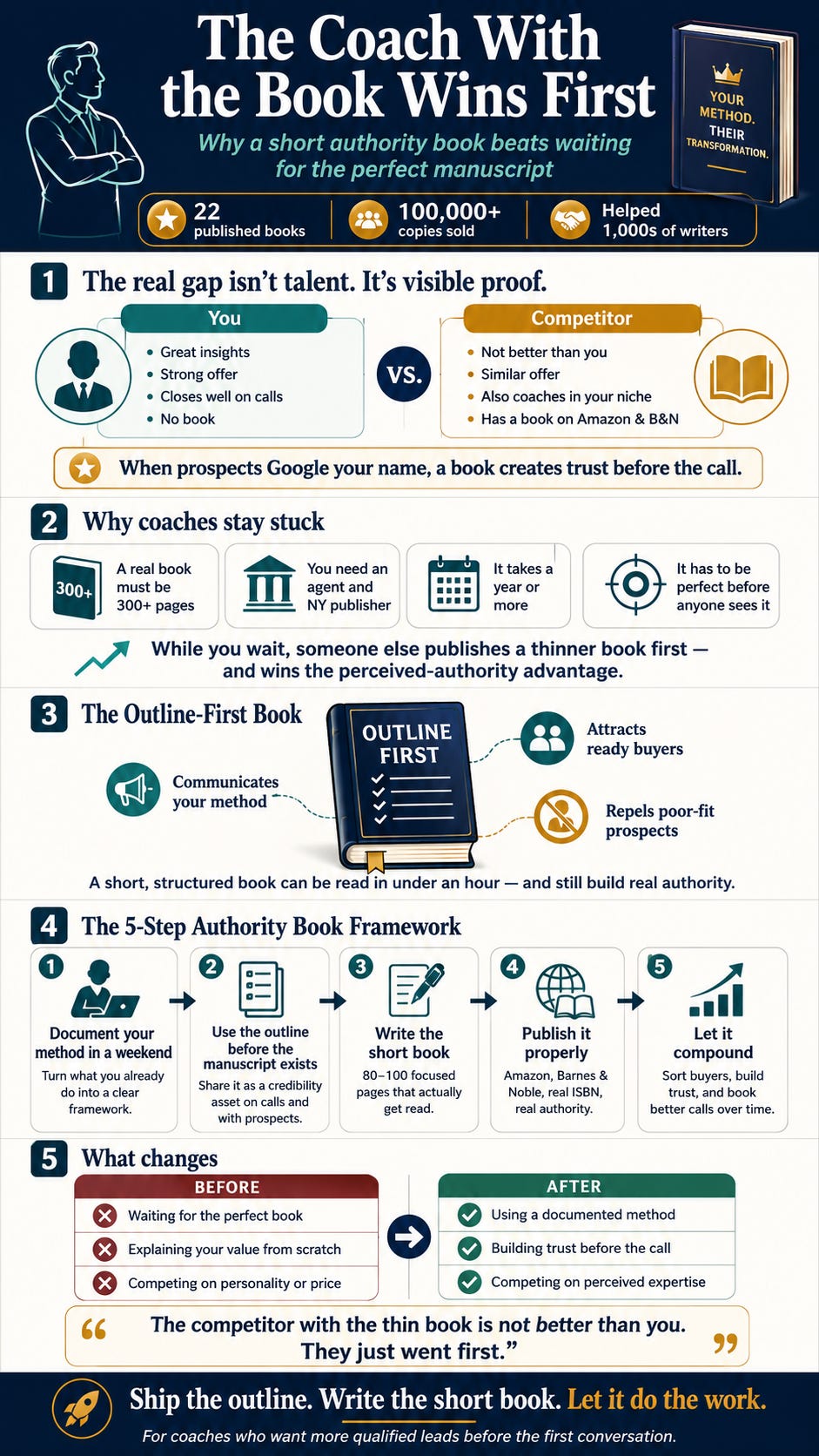
The Outline-First Book sorts faster and more efficiently.
Sketching out your framework into a book that can be read in less than an hour isn’t:
A draft you promise to finish someday.
A royalty play.
A sh*t ton of work.
The Outline-First Book is a structured, short book that...
communicates your method
Attracts ready buyers, and
Quietly repels everyone else.
The outline does the credibility work while you’re still writing.
The finished book — published on Amazon, Barnes & Noble, with a real ISBN, and real authority — becomes the asset that compounds.
You stop asking “how do I finish my book?” and start asking “how do I package my method so prospects find me before they find the other coach?”
Here is the framework in five steps:
1. Document your method in a weekend.
Not free-form journaling. Not “I’ll figure it out as I go.”
Structured prompts. Categories. A framework that forces you to articulate what you actually do with clients.
What problem you solve?
How do you solve it, and why does your way work?
You already have this in your head. You use it on every call. The weekend is for getting it onto paper.
Two days. One outline. Done.
2. Let the outline earn its keep before the manuscript exists.
Share the documented method with prospects. Use it as a leave-behind on sales calls. Send it to the people who asked “do you have anything I can read?”
The outline is not a rough draft. It is a credibility asset. It says: I have a method. It is documented. Here it is.
If the outline alone books one high-ticket client, the book already paid for itself. Before a single chapter is written.
3. Write the short book from the outline that is already working.
Eighty to a hundred pages. Not a magnum opus.
Mike Capuzzi, Dean Jackson, and others proved this years ago:
A tight, focused short book builds more trust than a bloated 300-page one, because it actually gets read.
The goal is not to impress with length.
The goal is to communicate your method so clearly that the right reader finishes it and thinks, “I need to work with this person.”
You are not writing for everyone. You are writing for the one who is ready to buy.
4. Publish it properly.
Amazon. Barnes & Noble. A real ISBN. One that readers can order from their local bookstore.
Not a PDF behind a landing page.
Not only a free download gated by email.
A book that shows up when a prospect searches your name.
A physical object you can hand someone after a speech or a call.
A leave-behind that travels.
The distribution strategy is the platform itself. When a prospect Googles you, the book is what they find. When they ask “who wrote the book on this?” the answer is your name.
Whether a physical or digital book, you can use it as an authority asset for that next workshop you’re giving.
It can be a shoe-in for that keynote.
5. Let the book compound as your credibility asset.
It sorts. It filters. It works while you sleep.
The book that got written because the outline booked the first client now books the next fifty.
Tire-kickers see the specific title and self-select out.
Qualified buyers read it and come to the call already sold on your authority.
You stop competing on price and personality.
You compete on perceived expertise and win by default.
You have been told a book takes a year or more. That it needs to be perfect. That you need a NY publisher and a finished manuscript before anyone takes you seriously.
None of that is true.
I published 22 books and moved over 100,000 copies while holding down a full-time corporate career and helping 1,000s of writers author their own work.
You do not need a finished manuscript to pre-sell authority. You need a documented method and the willingness to be seen.
Ship the outline. Write the short book. Let it do the work.
The competitor with a thin book on the bookshelf is not better than you. They just went first.
Now, it’s your turn.
If this article helped you reconnect with your writing, I’d love to have you as part of The Worthy Writer community.
If you’re not already subscribed, I’d be honored to have you join us. Every article is written to help overwhelmed writers create with more clarity, purpose, and joy.
If you’re already a subscriber and would like to help keep this publication free for everyone, consider becoming a paid subscriber. It’s about the cost of a cup of coffee each month, and your support helps me continue creating thoughtful resources for writers around the world.
Either way, thank you for spending these five minutes with me.
I (should) know this, but it is helpful to see it in this way, great job and thank you for posting it.